US warns embassy staff who want to leave Israel to hurry after latest US-Iran talks end without results
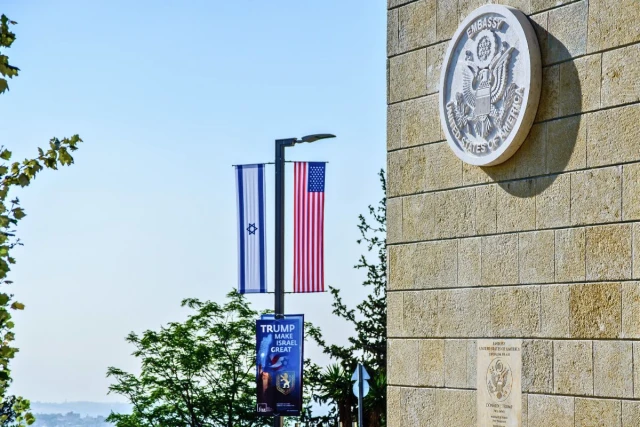
After evacuating most of its staff from Beirut, Lebanon, on Monday, the American embassy in Jerusalem told its staff to leave quickly if they wished to do so. Citing an email sent by Ambassador Mike Huckabee to his staff on Friday, The New York Times reported that personnel were urged to depart Israel for any destination outside the country.
“There is no need to panic,” Huckabee wrote, “but for those desiring to leave, it’s important to make plans to depart sooner rather than later.” He noted that there may not be more outbound flights in the coming days, another strong indication that the U.S. could be anticipating an escalation with the Islamic Republic.
Those wishing to leave “should do so TODAY,” Huckabee wrote, adding his instructions “will likely result in high demand for airline seats today.”
The U.S. has continued deploying military assets to the region, according to open-source information and American officials. Two dozen fighter jets, including additional F-22 Raptors, crossed the Atlantic Ocean in recent days to join numerous squadrons already positioned in bases in Israel, Jordan, and other countries.
In addition, another destroyer, the USS John Finn, joined the 11 warships already operating in the northern Arabian Sea, the Gulf of Oman and the Persian Gulf, an official told The Wall Street Journal (WSJ), while the aircraft carrier USS Gerald R. Ford was expected to reach the northern coast of Israel on Friday.
Huckabee’s instructions followed the end of the latest round of talks between the U.S. and Iran on Thursday. U.S. envoys Steve Witkoff and Jared Kushner presented several demands, including the complete dismantling of the Iran’s nuclear sites at Fordow, Natanz and Isfahan and the handover of all remaining enriched uranium to the U.S., officials told the WSJ.
The U.S. reportedly also demanded that a potential deal would be open-ended, meaning that, unlike the JCPOA nuclear deal negotiated by the Obama administration, nuclear limitations would be permanent. Iranian state media and sources cited by the WSJ said that the regime has rejected those conditions.
A new proposal presented by Iran was reportedly meant to counter U.S. “excuses” regarding the nuclear program while laying out “key elements of a potential agreement,” Iranian media stated.
A senior Iranian official told Reuters that the proposal could lead to results if the U.S. separates “nuclear and non-nuclear issues.”
Nevertheless, Oman’s foreign minister, who has been mediating the talks, expressed optimism on Thursday. Badr bin Hamad al-Busaidi described the talks as having made “significant progress” and added that discussions would continue in Vienna, Austria, next week.
The Jerusalem Post quoted a source saying the talks managed to “clarify” several issues, describing them as “positive,” and that a lower-level meeting is planned for next week.
During his State of the Union address on Wednesday, Trump stressed that he prefers a diplomatic solution, but noted, “We haven’t heard those secret words, ‘We will never have a nuclear weapon.’” He also argued that, in addition to its nuclear ambitions, the regime is the world’s largest sponsor of terrorism and has killed more than 30,000 protesters during the recent wave of demonstrations.
Trump was briefed by U.S. Central Command (CENTCOM) chief, Admiral Brad Cooper, on potential military options in Iran after the end of the talks on Thursday, the JPost reported, citing sources. ABC News added that General “Raizin” Caine, chairman of the Joint Chiefs of Staff, was also present.
Foreign Minister Al-Busaidi is scheduled to meet with U.S. Vice President JD Vance and other officials in Washington on Friday “in an effort to stave off war with Iran,” MS NOW reported on Thursday night.
Meanwhile, Vance said in an interview published by the Washington Post on Thursday that there was “no chance” U.S. strikes against Iran would lead to a prolonged war in the region.
Speaking to reporters aboard Air Force Two, Vance said he didn’t know what Trump would ultimately decide while noting that military strikes “to ensure Iran isn’t going to get a nuclear weapon,” or a diplomatic resolution, are among the possibilities.
“The idea that we’re going to be in a Middle Eastern war for years with no end in sight – there is no chance that will happen,” Vance stressed.
