By Vered Weiss, World Israel News
Israel’s security establishment is on heightened alert as intelligence points to growing Iranian involvement in Iraq, where Tehran is building up proxy forces capable of striking Israel by air or land.
Both the IDF and Mossad have been refining contingency plans in response to what officials describe as a slow but deliberate Iranian effort to open a new front against Israel.
Senior officers from the Northern Command say Iran has expanded funding and training for pro-Iranian militias across Iraq, strengthening logistical networks that could eventually enable coordinated attacks from hundreds of kilometers away.
These groups, operating under the Islamic Revolutionary Guard Corps–Quds Force, have received advanced weaponry and drones designed for long-range operations.
Quds Force commander Esmail Qaani reportedly visited Iraq in recent weeks to meet militia leaders and assess readiness for potential confrontation.
Security officials believe Iran’s long-term strategy involves not only bolstering its influence in Baghdad but also preparing these militias to act as a launchpad for future hostilities against Israel.
Defense analysts warn that the most likely form of aggression would be missile and drone launches from Iraqi territory, similar to patterns seen during last year’s war in Gaza.
A less probable but still concerning scenario envisions ground incursions originating in Iraq, crossing Syria, and approaching Israel’s eastern frontier near Jordan.
The Israel Air Force, in coordination with the United States, has already targeted Iranian-funded storage and command sites along the Iran–Iraq border.
These facilities were reportedly supplying weapons and equipment to Iraqi militias. In parallel, Israel’s 96th “Gilad” Division, commanded by Brig. Gen. Oren Simcha, has been running exercises in the Jordan Valley to simulate defense operations against such a multi-front escalation.
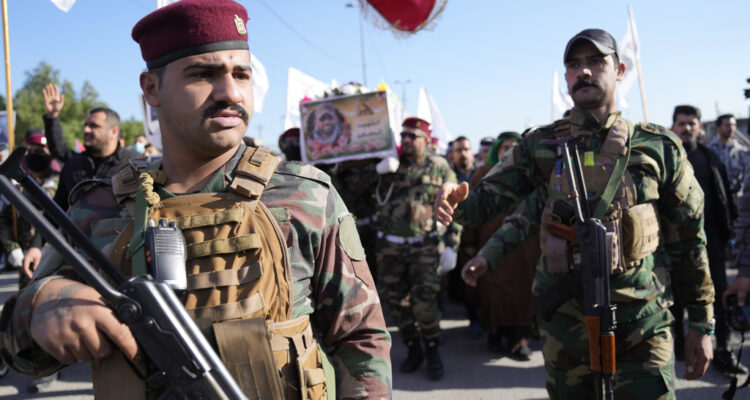
Among the most active Iranian-backed organizations is Kata’ib Hezbollah, a dominant force within Iraq’s Popular Mobilization Forces.
The group controls key smuggling routes into Syria, has previously attacked U.S. forces, and possesses a large fleet of drones and missiles. Israeli intelligence also identifies Harakat al-Nujaba—a Shiite faction with close ties to Hezbollah in Lebanon—as an emerging threat responsible for several past rocket attacks.
Israeli sources confirm that airstrikes have been carried out in recent months to disrupt militia buildup in Iraq. Diplomatic messages sent through Washington warned Baghdad that continued tolerance of Iranian activity could invite direct Israeli retaliation.
