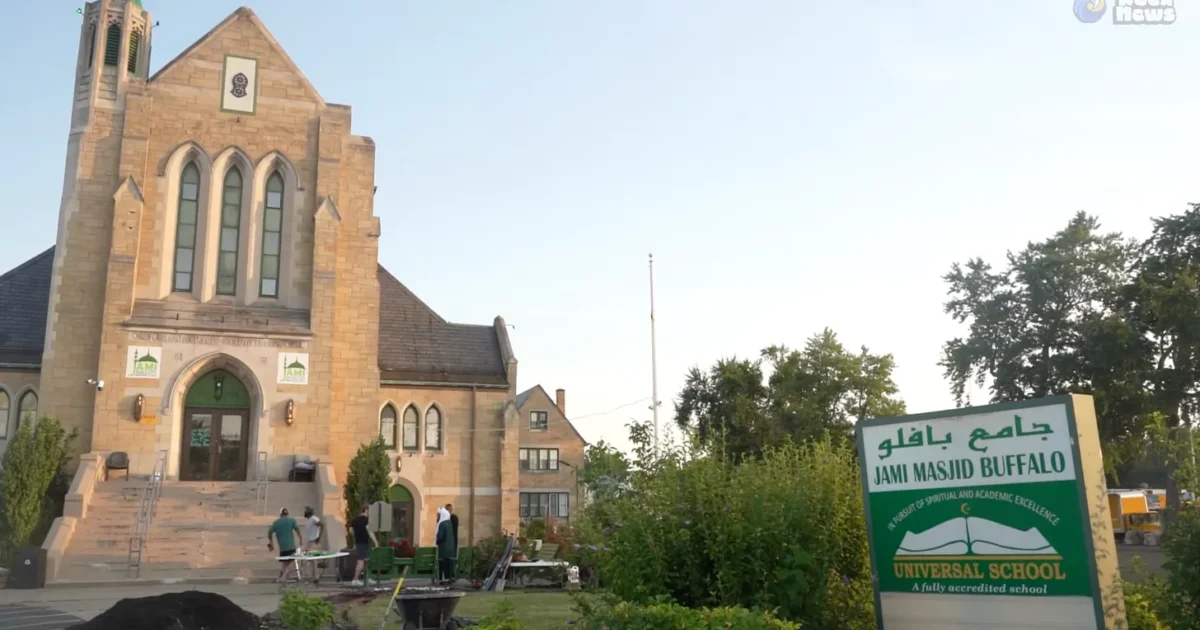
Once one of America’s most dangerous neighborhoods, East Buffalo has undergone a dramatic — and deeply symbolic — transformation. The streets once lined with abandoned Polish churches and crime-ridden rowhouses are now dotted with minarets, halal markets, and immigrant-owned corner stores.
The city that once defined America’s industrial might is being remade by mass migration and the quiet spread of Islam.
A Neighborhood Reborn — but Reclaimed by Another Civilization
The fall of Buffalo’s steel industry left entire blocks gutted. Polish-Catholic families fled. Churches closed their doors. Drugs, crime, and violence filled the vacuum.
Then came the mosques.
Catholic sanctuaries — once filled with hymns, weddings, and baptisms — were sold, stripped of their saints and stained glass, and re-dedicated to Allah.
“We used to call this Polonia,” one lifelong resident said. “Now it’s Medina.”
Dozens of former Catholic churches now bear Arabic names. Streets where crosses once stood now echo with the call to prayer.
The Islamic Takeover of East Buffalo
Immigrants from Pakistan, Bangladesh, Burma, and West Africa began arriving a decade ago — first from overseas, then from downstate New York. Cheap land, no-interest financing, and community-based networks allowed them to buy up entire blocks of foreclosed homes.
“This whole street was abandoned,” said one local. “Now every house is owned by Muslim families.”
Mosques have become community hubs — complete with gyms, jiu-jitsu programs, and basketball courts. But they also serve as powerful centers of ideological and cultural consolidation.
“We feed everyone,” one imam said. “That’s why so many people come — and that’s why they embrace Islam.”
The mosque’s basement doubles as a youth center, a training facility, and a conversion ground.
Anti-Christian Hatred Behind the ‘Revitalization’
In one former Polish Catholic church, now converted into a mosque, the imam proudly pointed to a stained-glass window once created by Catholics — and claimed it revealed “homosexuality” and “satanic imagery.”
“The devil,” he explained, “looks like an elephant… putting his trunk into the person’s heart to give bad thoughts.” He went on to describe what he believed were sexualized depictions of “a boy with his testicles” and “a fairy,” calling the art proof of moral corruption in the Catholic Church.
This disturbing exchange — dripping with contempt for Christianity and Western culture — captures the ideological undercurrent of the transformation now reshaping Buffalo.
A faith born in Europe’s cathedrals is being erased, replaced by one that views those very churches as monuments of sin.
The New Divide — Buffalo’s Identity in Question
Even longtime Black residents admit that the neighborhood feels “safer” — but at a cost.
“They buy all the houses, give each other jobs,” said one woman. “But none of that money goes back into our community. It stays in theirs.”
Others were blunter: “They taking over everything. Churches, stores, houses — all of it.”
For decades, East Buffalo begged the city and state for help. Nothing changed. Now, the transformation is happening — just not by the hands of the people who built it.
The Larger Story: From Abandonment to Islamization
Buffalo’s story is not unique. Across America’s Rust Belt, declining Christian communities are being replaced by growing Islamic enclaves. Refugee resettlement, migrant relocation, and federal incentives are accelerating the process.
What was once the heart of working-class America is becoming a new kind of cultural frontier — one where the symbols of faith, community, and identity are being rewritten in Arabic script.
The same pattern playing out in Buffalo is emerging in Rochester, Detroit, and Cleveland.
A Nation Sleepwalking Through Its Own Replacement
As one resident put it, “You’re not gonna see me go to Iraq to open a store.” Yet the reverse is now reality in city after city across America.
The churches are empty — but the mosques are full. The factories are gone — but the call to prayer rings out.
Instead of rebuilding our own neighborhoods, refilling our pews, and restoring our faith, America abandoned its cities — and its soul.
The solution our leaders chose wasn’t revival, but replacement — importing foreign populations whose loyalties lie not with our Constitution, but with a religious-political system determined to remake our nation in its own image.
This is not renewal. It’s not diversity. It’s a civilizational shift.
And while politicians and pundits celebrate “revitalization,” one question remains:
Revitalized for whom?
