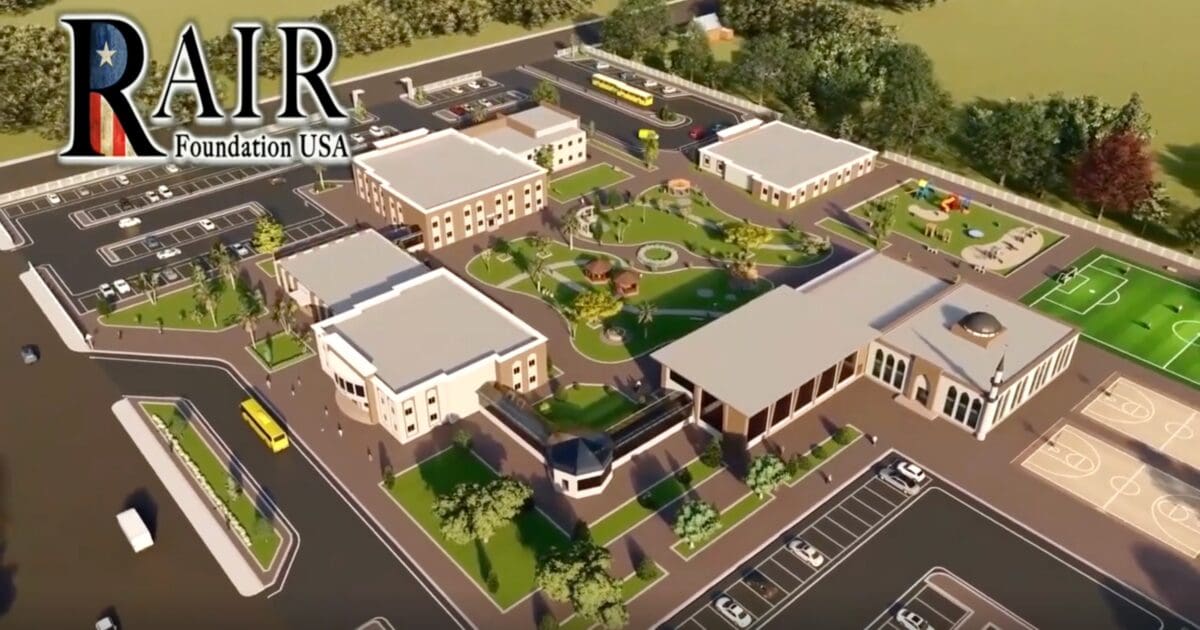
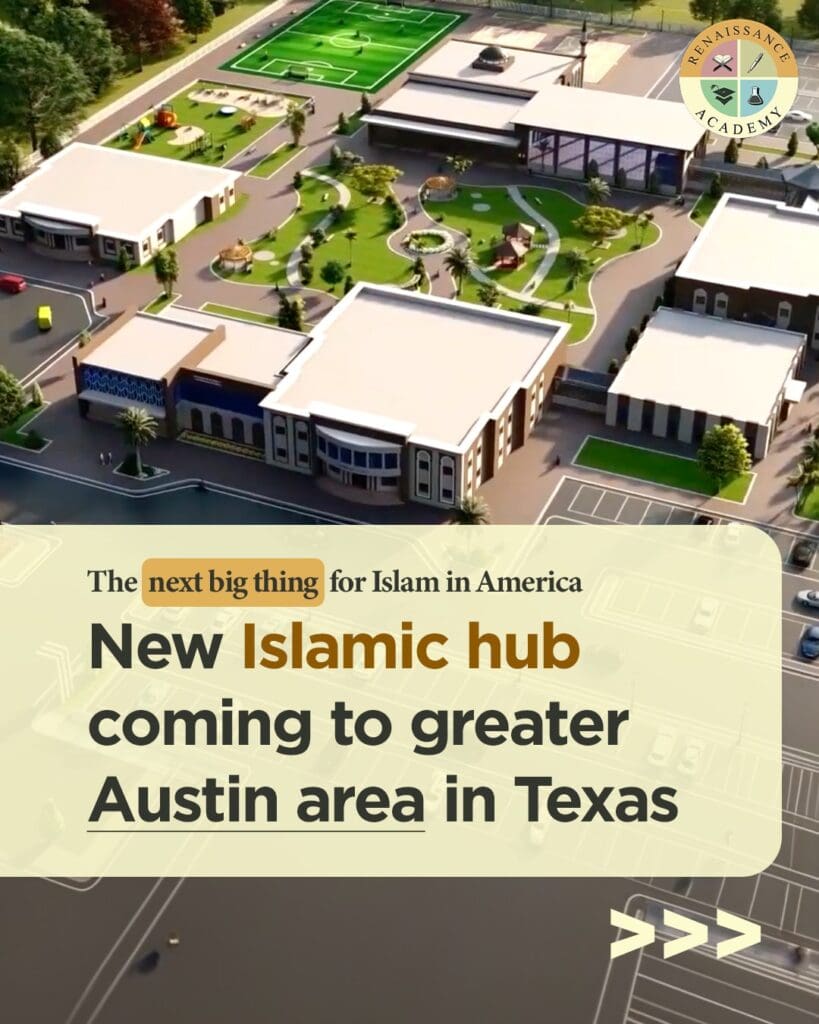
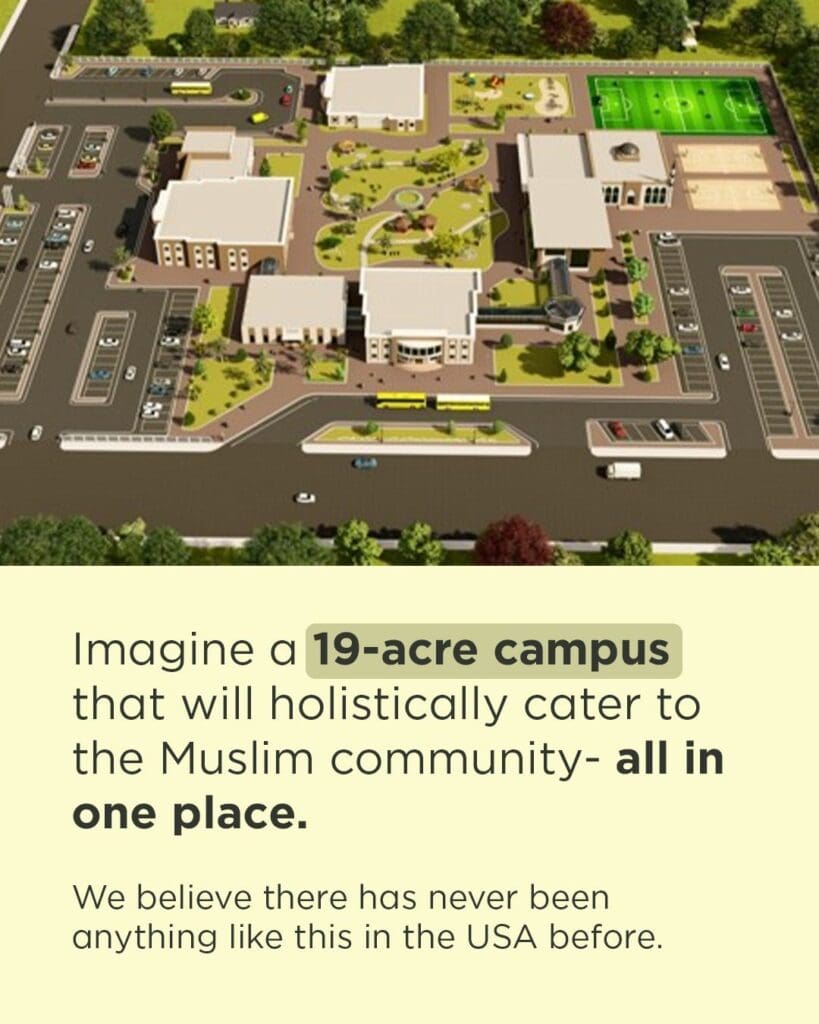
Renaissance Academy, an Islamic school deeply embedded in the North Austin Muslim institutional ecosystem, has launched a major expansion project that should set off alarms across Texas. The organization has secured a 19-acre site in Leander, raised millions, and publicly outlined plans for a full-scale Islamic campus that will include a masjid, K–12 school buildings, an auditorium, athletic facilities, and additional community infrastructure. This is not merely a school renovation or a larger building for overflow enrollment. This is a permanent Islamic institutional footprint expanding north of Austin in one of the state’s fastest-growing corridors.
This expansion is being marketed as a response to population growth and increased Muslim migration into Austin. The school admits it is at capacity and claims it has a waiting list of more than 200 students. This is the kind of language Texas residents have heard repeatedly as Islamic organizations scale their influence: claim rising demand, then build larger facilities, acquire more land, and entrench institutional systems that operate as long-term cultural and political infrastructure.
But this “growth narrative” is not occurring in a vacuum. Across Texas, Muslim organizations and affiliated institutions have actively promoted targeted relocation campaigns—encouraging Muslims from other states and countries to move into specific metropolitan corridors, consolidate community infrastructure, and expand mosque-centered institutional ecosystems. That matters because it reframes this expansion as more than a reaction to “organic” demographic change—it is consistent with a deliberate growth strategy: promote migration, establish demand, then leverage that demand to justify permanent institutional expansion.
And this is unfolding as Texas faces accelerating pressure campaigns tied to overseas Islamic influence networks. Yet even as Texas leadership acknowledges the risk posed by these ecosystems, Renaissance Academy’s expansion shows that the institutional buildout is not slowing down—it is accelerating, consolidating, and moving outward from Austin into surrounding suburban growth zones. This expansion is also unfolding after Governor Greg Abbott formally designated CAIR and the Muslim Brotherhood as foreign terrorist organizations and transnational criminal organizations in Texas, explicitly framing these networks as ideological infrastructure designed to impose Sharia and subvert American civil society.
In the state’s own words, Abbott said the designation “prohibits them from purchasing or acquiring land in Texas” and authorizes “heightened enforcement against both organizations and their affiliates.”
If Texas is serious about prohibiting terror-linked networks and their affiliates from acquiring land, then Texans deserve a clear answer: who reviewed this transaction, who approved it, and what enforcement mechanism is actually being applied?
A Sharia Financing and Sharia Asset-Control Structure—Not Just “Fundraising”
Renaissance Academy has publicly confirmed it raised $3.3 million to close on the Leander land purchase, and it is now soliciting an additional $1.7 million to pay down what it calls a “Qard Hasan” loan—an Islamic, interest-free financing mechanism structured to comply with Sharia’s prohibition on riba (interest). This is explicitly Sharia-compliant financing used to secure land quickly, close the deal, and then mobilize the community to repay the internal loan afterward. Renaissance Academy is using a Sharia-based financial structure to expand and entrench physical infrastructure in Texas.
But the most consequential detail is what Renaissance Academy says comes next. In its own FAQ about the new land purchase, the organization states that the newly acquired property will be registered in the name of the Renaissance Education Foundation, a Texas-based 501(c)(3), and then—after the facility is built—“the assets will be WAFQ (waqf) under a national organization such as North American Islamic Trust (NAIT).” This is the pivot point that transforms a real estate transaction into an institutional lock-in strategy. Renaissance Academy is describing a two-step pipeline: local nonprofit registration first, followed by conversion into a waqf-style endowment framework—a structure historically used to place religious property into long-term custody once it is transferred into permanent trust control.
Waqf is not ordinary nonprofit property. It is designed for permanence. In classical Islamic jurisprudence, waqf is treated as a permanent religious endowment that removes an asset from ordinary private ownership and restricts it to long term religious or institutional use. NAIT itself describes waqf holdings as restricted assets held on a perpetual basis and states that neither donors nor beneficiaries, and not even NAIT, can unilaterally dispose of them. That means this is not simply a school buying land and expanding a campus. It is a structure intended to lock the underlying asset into enduring religious custody, insulated from the normal mechanisms that allow property to be sold, dissolved, redirected, or unwound.
That permanence is precisely why waqf designated land can become the subject of prolonged legal conflict once ownership, governance, or control is contested, because the entire concept is built on the premise that the asset is not supposed to exit the waqf system. In India, for example, courts have repeatedly addressed high stakes waqf property disputes involving competing claims and institutional efforts to assert waqf authority, illustrating the real world enforcement pressure that comes with permanent endowment structures. Once waqf language enters a property transaction, it signals something more than growth. It signals entrenchment.
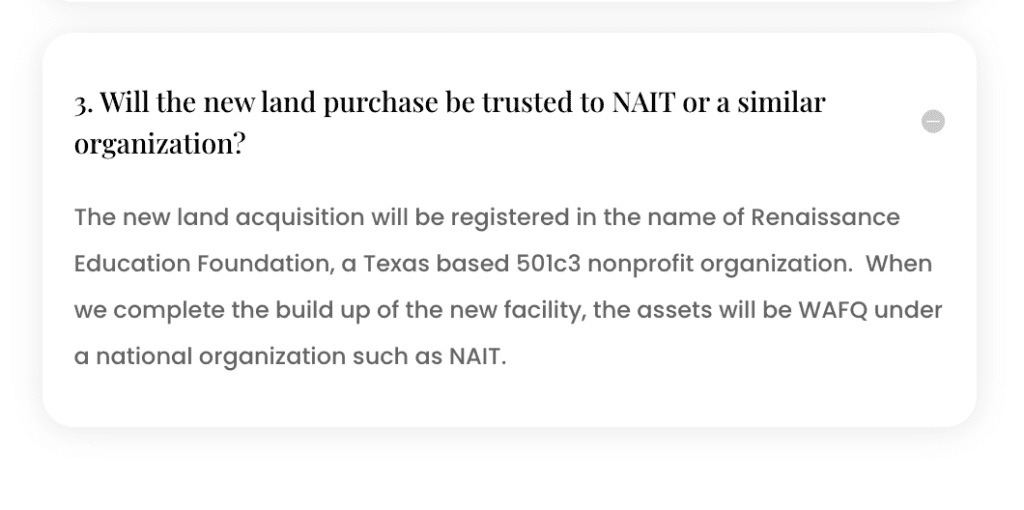
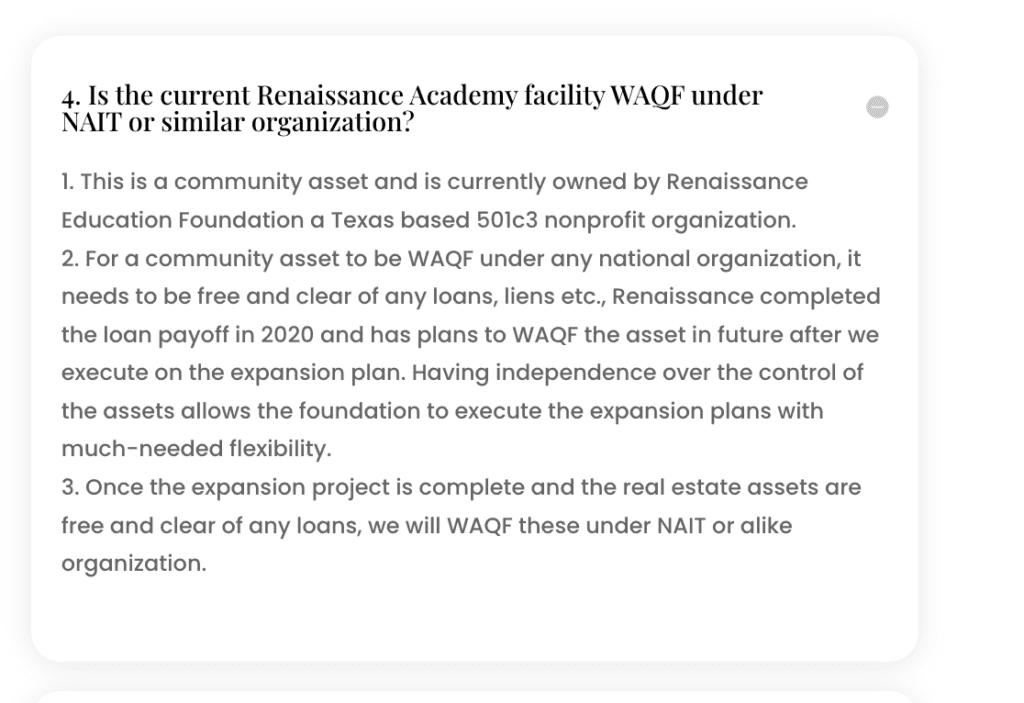
Renaissance Academy’s own materials also confirm this waqf/NAIT objective is not limited to the new Leander purchase. When asked whether the current Renaissance Academy facility is waqf under NAIT or a similar organization, the school states the existing campus is a “community asset” currently owned by the Renaissance Education Foundation. It then explains that for a community asset to be waqf under a national organization, the property must be “free and clear” of any loans or liens. Renaissance Academy states it completed its loan payoff in 2020 and plans to waqf the asset in the future after executing the expansion plan, adding that maintaining independence over asset control provides “much-needed flexibility” to carry out the expansion. The school then states plainly that once the expansion project is complete and the real estate assets are again free and clear of loans, it will waqf these under NAIT or a similar organization.
This language outlines a staged transfer plan: hold the property locally while expansion is executed, then transfer the fully paid asset into a national waqf framework once the land is free and clear.
Waqf (spelled “WAFQ” in their materials) is a Sharia-based endowment structure designed for permanence. In Islamic law, a waqf is intended to keep assets dedicated to religious or institutional purposes across generations. NAIT describes waqf as the permanent dedication of property “transferred to Allah,” with the property then used only for Sharia-compliant purposes. NAIT also describes itself as a waqf—functionally, the Islamic equivalent of a trust or endowment structure designed to hold and steward Islamic community assets in the long term.
This is why Renaissance Academy’s own language should alarm Texans. The school is not merely expanding its facilities. It is describing an end-state structure intended to be permanently dedicated and held under a national Islamic trust framework, rather than remaining solely a local community asset controlled only at the local level. Once an asset is structured as waqf under a national trust like NAIT, it is no longer treated like a standard nonprofit campus that can be easily redirected, sold, dissolved, or unwound. It becomes structurally insulated for long-term institutional use.
This is precisely why the NAIT reference matters. NAIT is not a neutral trustee—it has been repeatedly identified in federal case material and investigative reporting as part of the Muslim Brotherhood’s U.S. institutional infrastructure for holding and consolidating Islamic property. NAIT is widely described as a national property-holding vehicle for Islamic institutions, and it has been cited as holding title to hundreds of Islamic properties across the United States…
Reporting and investigative materials referencing FBI records have also described past federal scrutiny involving NAIT and related entities. The Investigative Project on Terrorism summarizes an Indianapolis-era FBI investigation described in FOIA-released material alleging NAIT and ISNA functioned as Muslim Brotherhood front groups, citing a case number and release date and describing internal investigative conclusions that placed these institutions within a broader Ikhwan network. Against that backdrop, Renaissance Academy’s stated intent to place assets under NAIT is far more than a routine real-estate decision.
RAIR Foundation USA has documented a consistent blueprint in Islamic school expansion campaigns: land acquisition, Sharia-compliant financing, and long-term property entrenchment through national Islamic trust structures. In Florida, RAIR reporting repeatedly identified NAIT in voucher-fueled Islamic school growth—and documented NAIT’s direct ties to the Elkadi family network, including Magda Elkadi Saleh’s maternal grandfather, Mahmoud Abu-Saud, a former NAIT president. Renaissance Academy is now describing the same architecture in Texas—Qard Hasan financing up front and waqf/NAIT custody on the back end.
In the Texas context, the NAIT/waqf language is significant because it ties the expansion not only to Sharia-compliant finance through Qard Hasan, but also to Sharia-compliant long-term asset custody, the creation of an endowment framework intended to lock the property into religious-institutional control for generations. This is the architecture of institutional permanence, not merely a school building campaign. It is the difference between growth and entrenchment.
This expansion is unfolding in a Texas environment where state leadership has already identified CAIR and Muslim Brotherhood networks as a hostile ideological threat. That makes Renaissance Academy’s own documented history even more alarming, especially given that its late imam urged followers to support CAIR and to organize politically. Against that backdrop, Renaissance Academy’s expansion cannot be dismissed as a neutral private-school project. The organization is openly describing a Sharia-linked financing-and-asset model designed for long-term consolidation, institutional permanence, and generational control of land and infrastructure in Texas.
The Financial Engine Behind the Expansion
Public IRS filings reinforce that Renaissance Academy is not operating as a small private school reacting to overflow enrollment. The Renaissance Education Foundation reports multi-million-dollar annual revenue, including approximately $3.3 million in revenue for the fiscal year ending July 2024, and net assets exceeding $4.1 million. The filings also show that the organization’s revenue is largely driven by “program services,” not merely donations, which signals a stable operational engine capable of sustaining long-term growth.
Payroll dominates reported expenses, with nearly two-thirds categorized as salaries and wages, demonstrating a professionalized staffing structure designed for scale. This financial footprint matters because it confirms the Leander expansion is being executed by an established institutional machine with ongoing revenue, expanding assets, and a long-term strategy to convert property into waqf custody once real estate is free and clear.
This is the financial backbone of permanence: stable revenue, expanding assets, and the ability to execute large-scale land acquisition while operating inside Sharia-compliant financing and waqf asset-transfer planning.
The Endgame: A Mosque + School + Trust-Controlled Land Base
Taken together, Renaissance Academy is describing a complete institutional blueprint: Sharia-compliant financing to acquire land, a mosque-centered campus to consolidate religious and academic life, and a waqf transfer plan under a national organization such as NAIT to lock the assets into permanent Islamic institutional custody. This is the construction of long-term infrastructure designed to endure, expand, and outlast public scrutiny.
Their stated destination is explicit: “the assets will be WAFQ under a national organization such as NAIT.” This is a compound model — land + school + mosque + permanent trust custody — built to expand and endure.
Corporate Matching: Targeting Corporate Systems to Expand Sharia-Compliant Growth
Renaissance Academy is also pushing corporate donation matching, listing major corporations such as IBM, Apple, Cisco, Microsoft, Visa, eBay, Qualcomm, AMD, Emerson, Samsung, and others. This does not automatically mean those companies are knowingly funding Renaissance Academy directly. What it does indicate is that Renaissance Academy is deliberately targeting corporate philanthropy systems to multiply donations and scale its expansion faster.
This is how sophisticated ideological institutions grow inside the United States. They do not merely pass a donation basket. They plug into corporate matching pipelines, professional donor networks, and high-income employment hubs—then leverage those financial systems to build permanent land-based institutions. The public is conditioned to see “matching gifts” as harmless charity mechanics. In reality, it is an acceleration mechanism for institutional expansion, and Renaissance Academy is openly using it.
A Masjid + K–12 Campus Is Not Education Alone—It Is Community Control Infrastructure
Renaissance Academy’s stated “vision” for the new site includes a masjid as a central component. That matters because a masjid is not simply a prayer space. In Islamic institutional life, the masjid is a command center for community consolidation, ideological reinforcement, leadership production, and long-term social governance. When it is physically integrated into a school campus, it becomes an engine for shaping children from early childhood through graduation inside a controlled religious ecosystem.
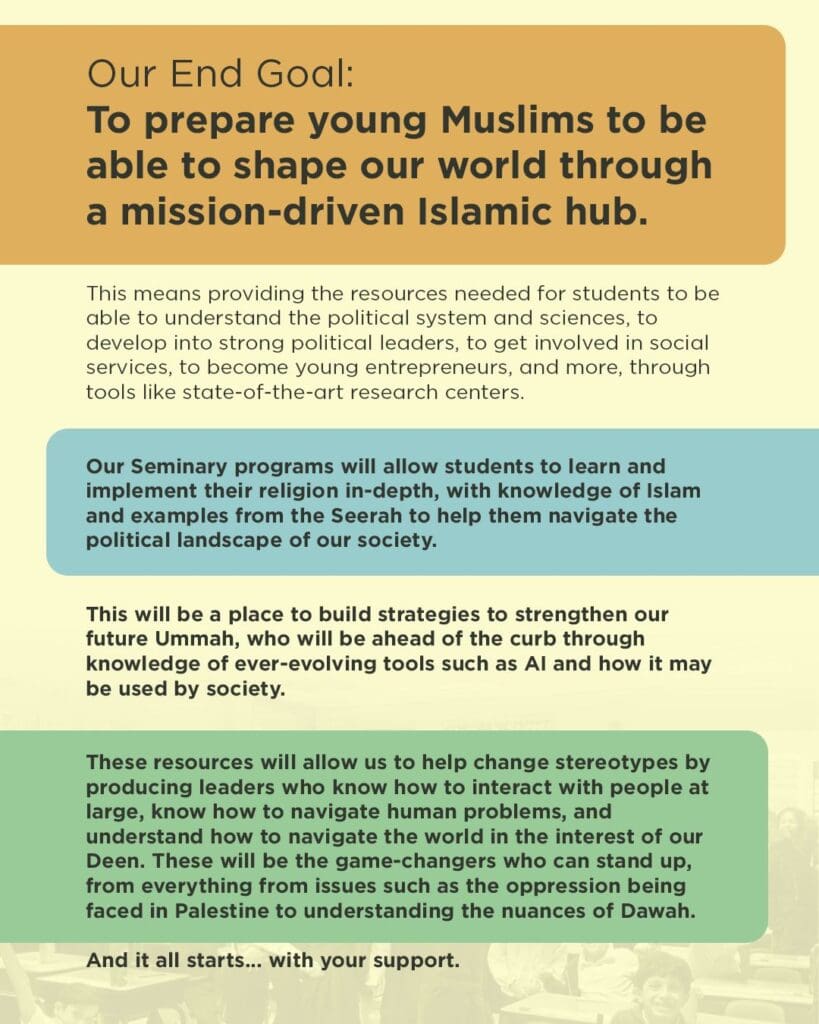
Renaissance Academy does not hide its goals. It states openly that its mission is to graduate students who will “fully live the values of Islam,” and it frames Islamic formation as the core product, not merely academic achievement. Its materials emphasize tarbiyah, Islamic Studies, Quran memorization, Arabic as an ideological connector language, and spiritual duties woven into daily school life. This is not “religious education.” It is a fully integrated worldview system.
The goal is not just to produce graduates who can attend college. The goal is to produce graduates who carry Islamic identity, Islamic obligation, and Islamic mission into the broader society. Renaissance Academy even states that its graduates will play a leading role in American society. That is not a neutral statement. It is an ambition statement about influence and long-term placement.
The Staff Bios Reveal the Curriculum Reality: Arabic, Quran, Islamic Studies as Institutional Priorities
Renaissance Academy’s “Meet the Team” materials provide additional insight into the ideological emphasis embedded in staffing. The school’s vice principal, Laila Khater, is specifically described as teaching Arabic, Quran, and Islamic Studies across grade levels, and serving as head of the elementary department and vice principal. That is a leadership role directly tied to religious curriculum enforcement.
This is important because Renaissance Academy’s expansion is not only about facilities. It is about scaling personnel capable of delivering Islamic instruction as a central pillar of the student experience. The presence of staff whose primary function includes Quran and Islamic Studies shows that the religious mission is operational, not symbolic.
Other staff materials highlight long-term internal community roles and multi-decade tenures at the institution, reinforcing that Renaissance Academy is not a new school experimenting with an educational model. It is an established ideological institution that builds permanence and scales outward through land acquisition.
The Most Dangerous Component: Renaissance Academy’s Islamic Clerical History
Renaissance Academy’s expansion becomes far more alarming when placed against the documented history of Islamic messaging from its late imam, Islam Mossaad. Mossaad did not merely express political opinions. He framed conflict in civilizational terms and urged Muslims in the West to organize and mobilize.
In a post circulated publicly in 2025, Mossaad called for Muslims to ally with Marxists and Socialists until “Zion American Imperialism falls to its knees.” That is a direct call for ideological coalition warfare against the United States and its allies, using the language of domination, defeat, and submission. This is not interfaith cooperation, and it is not peaceful civic engagement. It is a strategic alignment proposal between Islamic ideology and revolutionary left movements—two forces that share a common objective: dismantling Western cultural authority.
Mossaad also urged support for CAIR as an organizing and strategy vehicle. That detail is now especially significant because Governor Greg Abbott has formally designated CAIR as terror-linked. Texans are being told on one hand that CAIR is tied to extremist networks, while Islamic institutions continue building pipelines and infrastructure that intersect with the same ecosystem.
This is how ideological networks survive enforcement pressure. They replicate through schools, nonprofits, and community foundations—always one step removed from the point of public scrutiny.
Texas Is Not Watching “Growth”—Texas Is Watching a System Expand
It is not enough to describe Renaissance Academy’s Leander expansion as a school growing because families want a faith-based alternative. The expansion reflects something bigger: a parallel institutional ecosystem expanding rapidly through land acquisition, Sharia-compliant finance, controlled education environments, and ideological leadership production. This is how Islamization looks in real time. It looks like a clean brochure, a shiny campus plan, and “community fundraising.” But the structure underneath it is religious governance, religious finance, and long-term institutional capture.
Renaissance Academy is telling the public, plainly, that it intends to build a larger Islamic campus that includes a masjid, expand its capacity, and shape the next generation through a system that openly prioritizes Islamic identity and Islamic mission. That is exactly what ideological infrastructure expansion looks like, and it is happening in Texas right now—rapidly, strategically, and with significant funding power.
The question Texans must ask is not whether Renaissance Academy has a right to exist. The question is whether Texas leaders are willing to confront the reality that the state is being transformed through the construction of parallel systems that reject assimilation, build Sharia-compliant financial frameworks, and scale influence through education.
And once they are built, they don’t go away. They become permanent.
