‘Every rock’ overturned? D.C. pipe bomb arrest raises questions about Christopher Wray’s FBI
Public deserves to know if it’s ‘another example of a federal investigation compromised by political considerations’
It’s a tale of two investigations.
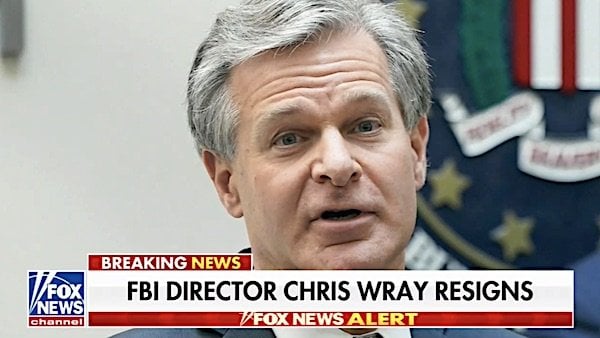
In one version – based on past comments by former FBI Director Christopher Wray – the arrest last week of Brian Cole Jr. as the individual who allegedly placed pipe bombs near the Washington, D.C., headquarters of the Democratic National Committee and Republican National Committee on Jan. 5, 2021, was the culmination of a dogged, five-year effort by the bureau.
In another version, suggested by Dan Bongino, the bureau’s deputy director, FBI agents revived a long-dormant case a few months ago, quickly tracking down Cole through an existing body of evidence, not from new information. At a press conference following Cole’s arrest last week, Bongino said he assigned a fresh team of investigators out of the Washington FBI field office about two months ago that “scoured [existing evidence] over and over and over and over again.” Key pieces of evidence gathered under the previous administration – including credit card purchases of components used to construct the devices, as well as cell phone and vehicle activity from Jan. 5 – led investigators to Cole.
Given the case’s close connection to the highly-charged events of Jan. 6, questions are also being raised about whether Wray’s FBI essentially put the case on hold for political reasons. Such concerns stem, in part, from the bureau’s documented role in helping advance the discredited Russiagate narrative used against President Trump and its decision to remain silent as the Biden campaign dismissed Hunter Biden’s laptop as a “Russian plant” in the closing days of the 2020 campaign – despite the bureau having already verified its authenticity.
‘Every Rock’ Overturned
Although the bombs allegedly planted by Cole, who faces two federal charges relating to possession of an explosive device, never went off, law enforcement has always treated the bombs as possible instruments of mass casualties.
In the days after the Jan. 6 Capitol protest, top law enforcement officials promised to use all investigative resources necessary to track down the pipe bomb perpetrator. “Every tool, every rock is being unturned because we have to bring that person to justice,” Steven D’Antuono, head of the Washington FBI field office at the time, told reporters on Jan. 12, 2021. He also announced a $50,000 reward for anyone providing information leading to an arrest.
Acting U.S. Attorney for the District of Columbia Michael Sherwin, who joined D’Antuono during the presser, even warned that felony murder charges “related to the use of destructive devices” could await the pipe bomber despite the fact that the devices did not detonate.
Records show the FBI devoted massive resources to the investigation in early 2021. A team of at least 50 FBI agents collected security camera footage, interviews, apparel purchases, cell phone records, police transmissions, and other evidence, resulting in a trove of 105 million data points by April 2021. Tips poured in from the public; analysts quickly identified the components, including a kitchen timer and a steel pipe used to construct the devices.
The FBI doubled the reward and released video clips of the alleged suspect, who was wearing a hoodie, distinctive Nike sneakers, and a face mask while carrying a backpack around the Capitol Hill neighborhood.
D’Antuono made another urgent plea for the public’s help in March 2021. “We know it can be a difficult decision to report information about family, friends, or co-workers, but this is about protecting human life,” he said in a five-minute video posted on the FBI’s website. Authorities continued to insist the devices had been “viable” and capable of injuring or killing bystanders.
In June 2021, Wray again told Congress under oath that the FBI was “aggressively investigating” who had planted the devices.
Troubling Details
But even as the FBI assured the public it was conducting a vigorous investigation, journalists and Republicans in Congress were uncovering troubling details surrounding the discovery of both devices. In January 2022, Politico reported that Sen. Kamala Harris, the incoming vice president, had been inside DNC headquarters when a plain-clothes Capitol Police officer found the pipe bomb under a bush between two benches next to the driveway of the building – the same driveway Harris’ Secret Service detail had used when she arrived a few hours earlier.
That disclosure raised concerns over the Secret Service’s sweep of the premises earlier that day, as did the discovery of security camera footage showing bomb-sniffing canine units twice deployed near the spot where the device was later found. Even after the device was discovered, video shows law enforcement acting nonchalantly about the potential danger – even allowing a group of schoolchildren to walk past the area. Adding to the mystery is a Quantico report that determined the devices at both the DNC and RNC were nonoperational – a finding, if true, that is likely to be trumpeted by Cole’s lawyers.
In another odd twist, Karlin Younger, the woman who found the pipe bomb near the RNC at 12:40 p.m. on Jan. 6, worked for FirstNet – the same provider that later told the FBI the cell phone data for Jan. 5 had been corrupted and was not recoverable. According to Bongino, the cell phone data had not been corrupted and was crucial evidence that led to Cole’s arrest.
Demand for More Answers
Rep. Barry Loudermilk, chairman of a new select subcommittee on Jan. 6, wants more answers on the circumstances surrounding both discoveries. This week, he sent a letter to Younger asking her to sit for a transcribed interview before his new select subcommittee on January 6. He has previously asked the director of the Secret Service to make the agents on Harris’ security detail that day available for questioning. Loudermilk has also said he plans to explore the destruction of evidence – including the deletion of Secret Services text messages before and on January 6 and of video images from the DNC and RNC on Jan. 6. “As we go and looking for video on January 6th to see did anybody go back to these locations, that footage doesn’t exist anymore,” he told podcaster Benny Johnson. “We have January 5th video, but we were told no one preserved January 6th. … This has inhibited our investigation.”
The revelation of those curious circumstances as the FBI investigation dragged on put Wray on the defensive. He refused to discuss details about the investigation with Republican Rep. Thomas Massie during a 2023 House Judiciary Committee hearing and would not confirm whether the FBI interviewed the officer who found the DNC device.
During a heated 2023 exchange with Rep. Eli Crane, an Arizona Republican, Wray said, “We [the FBI] have an entire dedicated team focused specifically on this investigation.”
Wray also told the Arizona Republican, which had challenged him to explain the successful roundup of hundreds of J6 protesters but not the individual responsible for a potential “mass casualty” event that day, “We’ve done thousands of interviews, we’ve visited thousands of residents and businesses, viewed millions of pieces of data, there’s something like 39,000 video files, and we’ve assessed like 500 or so tips. We’ve done extensive public publicity, we’ve increased the reward money.” Wray further claimed that the FBI laboratory, weapons of mass destruction unit, technology division, and “cellular analysis team” were still hot on the pipe bomber’s trail. “I, as much as anybody, would like to see it solved.”
In a 2023 interview with Fox News’ Bret Baier, Wray said the FBI had devoted “loads” of resources to the investigation and that he had “enormous confidence” in his team assigned to the pipe bomb case.
But when Wray retired shortly before President Trump took office for the second time, a full four years after the launch of the investigation, the pipe bomb case remained unsolved.
More Headscratchers
Others doubt Wray’s assurances that this case remained a priority on his watch. A January 2025 update on the pipe bomb matter overseen by Loudermilk and Massie asserted, based on law enforcement correspondence, that interest in the case waned as early as one month after the Capitol protest. “By the end of February 2021, the FBI began diverting resources away from the pipe bomb investigation,” the report stated, citing as a reference a Feb. 2021 email from an unidentified Capitol Police official. “One possible explanation for the reduction in resources is that the number of credible leads began to decline, no longer requiring as many special agents to cover the workload.”
Perhaps the biggest headscratcher – how the new team of investigators used cell phone data that D’Antuono claimed had been corrupted – demands answers. In sworn testimony to Congress, D’Antuono had told lawmakers that the FBI “did a complete geofence” for the night of Jan. 5 but that “some data was corrupted by one of the providers.” That assertion appears to be false.
Congress appears interested in determining how Wray’s FBI came up empty-handed. A House Judiciary Committee spokesman told RCI “everything is on the table” in terms of getting answers from the former director about the pipe bomb investigation. Efforts to reach Wray and D’Antuono for comment were unsuccessful.
But the public is entitled to know whether the investigation begun during Wray’s tenure was simply a case that took five years to bring to fruition – or whether it is another example of a federal investigation compromised by political considerations.
