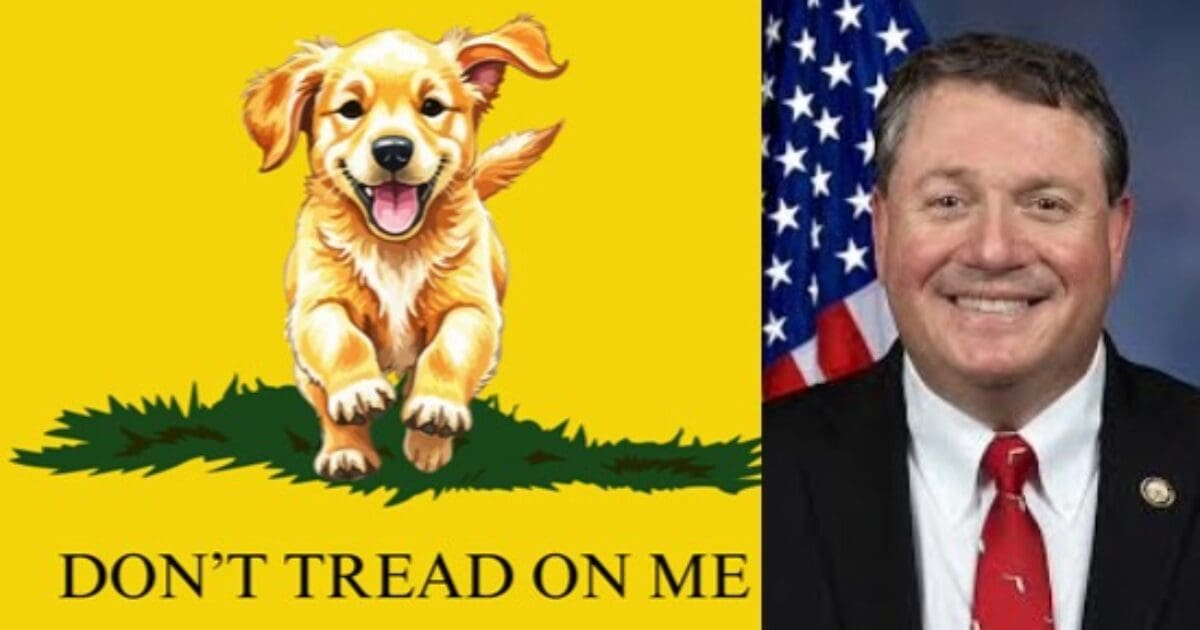
The backlash against Congressman Randy Fine for speaking plainly about Islam exposes the West’s central contradiction. Politicians routinely claim they oppose Sharia, yet condemn anyone who actually recognizes what Sharia is.
Mr. Fine wrote on X: “If they force us to choose, the choice between dogs and Muslims is not a difficult one.”
This followed a post by the leader of one of the key Islamic groups that supported the new Mayor of New York City. She wrote: “Finally, NYC is coming to Islam. Dogs definitely have a place in society, just not as indoor pets. Like we’ve said all along, they are unclean.”
Forced to choose between sharia and Western values, the representative chose Western values and flatly rejected the United States “coming to Islam.”
The “we” in her comment refers to the global Islamic community, the ummah, whose doctrine forbids owning dogs except for work purposes and teaches that non-working dogs should be killed, particularly black dogs. This reflects Islamic legal teaching, where dogs are ritually impure and Islamic expansion is treated as a religious objective.
The same issue recently surfaced in the U.K., following a government report citing complaints from the Islamic community about dogs permitted on protected public lands and parks.
- “He [Mohammed] ordered that dogs be killed, then he said: What about other dogs? He then made an exception for the hunting dog and the herding dog, and he said: When a dog licks a vessel, wash it seven times and rub it with earth the eighth time. (Muslim 280a)
- Black dogs were singled out as devils and killed (Tirmidhi 338)
That dogs are considered severe filth is made clear in halal sanitation standards. Contamination by blood, vomit, or pus is considered “moderate.” Contamination by dogs or pigs is “severe,” requiring the special cleaning method drawn directly from the hadith above. The word used for this severe impurity is najas.
What the post’s author failed to disclose is that unbelievers – non-Muslims – are likewise considered impure:
- Koran 9:28 ‘O you who believe! Verily, the Mushrikun [unbelievers] are najasun (impure)’
- “When there is a fear that a non-Muslim might touch [the Koran]… it should be picked up if there is no safe place to put it…” (Reliance of the Traveller e8.3)
When politicians rush to condemn a congressman for acknowledging these realities while claiming to oppose sharia, they reveal the real problem: fear of confronting doctrine.

The Koran explicitly discourages friendship and loyalty with both non-Muslims and dogs:
- Koran 5:51 ‚ O you who have believed, do not take the Jews and the Christians as allies…’
Islamic law institutionalizes discrimination through sharia, placing non-Muslims in a subordinate legal category under Islamic rule, as documented across Islamic states and codified in classical jurisprudence.
When Congressman Fine said he would not accept being “conquered like the Europeans,” he was referencing a visible reality: steady accommodation of Islamic legal demands across Western institutions, from sharia-based arbitration in courts to state-funded Islamic schools and financial systems structured around Islamic law – sharia. In the U.K., the King of England has again honoured Ramadan while ignoring traditional observances of the native population.
The response from the Council on American Islamic Relations (CAIR), designated as a terrorist organization in Texas and the UAE, and from political leaders follows a familiar pattern: avoid the doctrine, attack the messenger.
The same avoidance evident in the U.K. and E.U. appears in the United States, where officials treat Islam exclusively as a private faith while ignoring its governing structure. Senators may swear oaths on any text, but the deeper issue is whether lawmakers recognize that Islamic doctrine is not confined to spirituality. A legal system premised on individual conscience and equal protection cannot simply substitute one holy book for another and expect the same outcomes.
At the February 10 congressional hearing, Thomas Jefferson was invoked to justify modern accommodation of Islam. Jefferson owned a copy of the Koran and wrote that ‘Mahometans’ should not be excluded from civil rights.
In the 18th century, civil rights meant property ownership, access to courts, and personal liberty. It did not contemplate state-supported religious schools, sharia arbitration, Islamic finance, or parallel legal authority. Jefferson had access only to the Koran itself, not the hadith collections and classical sharia manuals that transform verses into a comprehensive system of governance.
Holding modern democracies hostage to notes written with limited doctrinal knowledge and never intended to justify competing legal systems makes no constitutional sense.
What emboldens Islam is not criticism. It is accommodation.
Islamic doctrine itself makes clear that its system is meant to govern. When that governance cannot be achieved, relocation is presented as a religious obligation:
- Koran 4:97 … The angels will say, “Was not the earth of Allah spacious [enough] for you to emigrate therein?”
Those who cannot live where Islam is fully implemented are instructed to leave for lands where it can be.
The logic is unmistakable. Islam demands authority, social control, and legal supremacy. Where that cannot be imposed, the doctrine directs believers elsewhere.
There are already fifty-seven Islamic states where sharia shapes law to varying degrees. For women, minorities, and dissenters living under those systems, that number is already far too high.
Western constitutional systems rest on voluntary belief, equal protection, and the separation of religion from law. A doctrine that mandates hierarchy, legal inequality, and supremacy cannot coexist with those principles without dismantling them.
The consequences of merging theology with state power are visible wherever Sharia governs. In Iran, mass repression is justified through religious authority. Force against dissent is grounded directly in scripture:
- Koran 8:39 And fight them until there is no fitnah and [until] the religion, all of it, is for Allah.
Violence is presented as divine action rather than human accountability:
- Koran 8:17 And you did not kill them, but it was Allah who killed them. And you threw not, [O Muhammad], when you threw, but it was Allah who threw that He might test the believers with a good test.
This is not ethnic conflict and certainly not ‘racism’. It is the outcome of a legal system that fuses divine command with state coercion.
Acknowledging this is not racism. It is literacy.
Acquiescence does not produce harmony; it promotes Islamization and emboldens those who demand compliance with sharia.
Islam does not advance primarily through open conquest in the modern West. It advances through willful blindness to its legal nature, institutional accommodation, and the silencing of those who speak plainly.
This debate is about whether constitutional societies will defend their legal foundations or continue surrendering them incrementally to a system that explicitly rejects equality before the law.
Randy Fine is not the problem.
The problem is a political culture that refuses to confront what Islamic doctrine actually requires.
No one is being targeted for private belief. The issue is a religious system that:
- forbids equal legal standing
- enforces separation between believers and non-believers
- mandates supremacy once political authority is achieved
- prohibits owning dogs as pets and orders their killing
- demands death for apostasy and permits slavery
That is why Islamic states deny universal human rights and subscribe instead to the Cairo Declaration, grounded in sharia.
For Islam, opposition to sharia is framed as “defensive” jihad – perpetual victimhood used to justify pressure and expansion.
- Koran 5:33 Indeed, the penalty for those who wage war against Allah and His Messenger and strive upon earth to cause corruption is none but that they be killed or crucified or that their hands and feet be cut off from opposite sides or that they be exiled from the land.
“Islamophobia” functions as the predictable outcry deployed to silence criticism. It has worn out its welcome in countries that were once among the most tolerant in the world, now lectured to by adherents of belief systems protected in some of the most intolerant societies on earth.
Man’s best friend jeopardized by a belief system that forbids such friendship? Choosing freedom is not only easy but also imperative.
