As split in Iranian leadership becomes evident, military officer says fall of regime is ‘inevitable’
Cracks within leadership, deaths among security forces could lead to ‘guerrilla warfare,’ experts say
The report cited anonymous officials who told Reuters that strain is already evident among the surviving leadership, which is partially behind the pressure to declare a new Supreme Leader.
Alex Vatanka, a senior fellow at the Middle East Institute, told Reuters, “Wartime tends to clarify power structures, and in this case the decisive voice is not that of the civilian leadership but of the IRGC.”
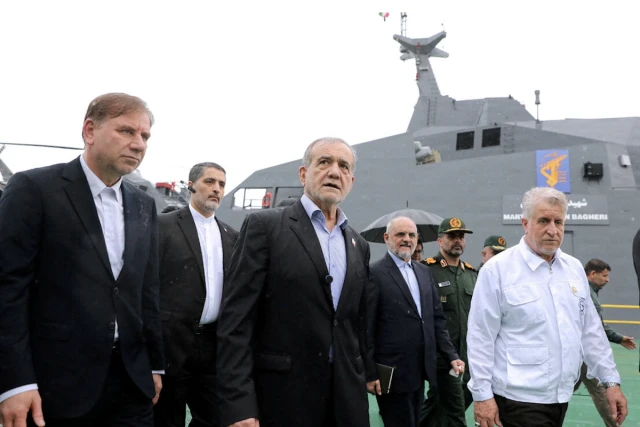
The split in the Iranian leadership was also clear when Iranian President Masoud Pezeshkian apologized to neighboring Gulf states for attacks that had targeted those countries.
“I must apologize on my own behalf and on behalf of Iran to the neighboring countries that were attacked by Iran,” Pezeshkian said in a speech broadcast on public television. “The interim leadership council agreed yesterday that no more attacks will be made on neighboring countries and no missiles will be fired unless an attack on Iran originates from those countries.”
Pezeshkian’s apology to the Gulf states was immediately criticized by hardline cleric and lawmaker Hamid Rasaee, who wrote to 𝕏, “Mr. Pezeshkian! Your stance was astonishing, unprofessional, weak, and unacceptable.”
“The armed forces did not act with ‘fire at will’ and without coordination, but rather carried out their reciprocal response based on deterrence policy, fulfilling their duty admirably,” Rasaee continued. “Those who should apologize are the countries that have turned their soil into a base for the U.S. military.”
He also continued to attack Pezeshkian in later posts, while calling for the Assembly of Experts to immediately announce the successor to Khamenei.
Just hours after Pezeshkian’s statement, missile and drone attacks on a number of Gulf states, including Kuwait, Saudi Arabia, and the United Arab Emirates, were reported. Those attacks continued into Sunday morning.
However, Iran’s chief justice Gholam-Hossein Mohseni-Eje’i accused several of the Gulf states of aiding the U.S. war effort, saying, “The attacks against American targets continue. The territories of some of the countries in the region are openly and covertly in the hands of the enemy, and these points are used to attack our country. The harsh attacks against these targets will continue.”
The disagreement between the two leaders indicates that the regime is not as unified after the death of Ayatollah Khamenei. An official close to Khamenei’s office, which continues to play a role in governing, told Reuters that Pezeshkian’s comments angered many senior commanders in the IRGC.
Since the start of the campaign against Iran about a week ago, the IDF has been accumulating assessments pointing to severe and unprecedented damage to Iran’s internal security forces, Channel 12 reported. According to the data, thousands of casualties were counted among these forces throughout the days of fighting.
An officer in Iran’s military forces told The Media Line that the fall of the Iranian regime is “inevitable,” saying members of the IRGC, the Basij, and other regime forces deployed in the streets have become fatigued and desperate.
He said that the bombing campaign carried out by Israel and the U.S., targeting IRGC and Basij headquarters and infrastructure, is weakening the resolve of the forces and fracturing the command structure. He assessed that it could lead to defections by members of those forces and could allow protesters to seize the opportunity to begin taking over cities from the regime.
Emily Blout, an Iran specialist with policy and research experience at the Pentagon, told The Media Line that this could still lead to “weeks or even months of guerrilla warfare.”
She warned that the regime could consider this crisis their “Karbala moment,” a reference to the battle which led to the Sunni-Shia split, when Husayn ibn Ali, the grandson of Muhammed, was killed by the Umayyad forces. In Shia sources, references to Karbala often accompany calls for endurance and a willingness to embrace martyrdom.
“This will not be an easy endgame,” Blout said.
Prime Minister Benjamin Netanyahu, in an attempt to increase the pressure on the regime, directly addressed members of the Islamic Revolutionary Guard Corps on Saturday. In a video message aimed primarily at the Israeli public, Netanyahu also addressed IRGC members, telling them they would be spared if they laid down their weapons.
“To the Revolutionary Guards operatives, those who are fighting the Iranian people in the streets, I say only this: You are also in the crosshairs. Whoever lays down their weapons will not be harmed. Whoever does not do so, their blood will be on their heads,” Prime Minister Netanyahu said.
He also directly addressed the Iranian populace, reaffirming that Israel has no fight with the people of Iran.
“The moment of truth is approaching. We do not seek to divide Iran, we seek to liberate Iran. To free her from the yoke of tyranny and to live with her in peace,” he stated. “At the end of the day, liberation from the yoke of tyranny will depend on you, the brave and learned Iranian people. I believe that if you stand up at the moment of truth, the day will not be far when Israel and Iran will return to being brave friends.”
Meanwhile, the Israeli government assesses that Mojtaba Khamenei, the son of the assassinated Supreme Leader Ali Khamenei, is still alive. According to reports in Israeli media, Mojtaba was wounded in an attempt to assassinate him shortly after his father’s death.
Despite reports of severe damage to the compound where he was staying at the time of the strike, the current assessment is that he survived the attack. His condition is unknown, and there is a heavy media blackout by the regime regarding his status.
One of Iran’s leading clerics, Ayatollah Nouri Hamdani, said the Assembly of Experts “must expedite the process [of selection] in order to disappoint the enemy and preserve the unity and solidarity of the nation.”
